How to Scale Facebook Ads in 2025 Without Killing ROAS

A presentation at How to Scale Facebook Ads in 2025 Without Killing ROAS in January 2026 in Austin, TX, USA by AGrowth

Slide 1

Slide 1

How to Scale Facebook Ads in 2025 Without Killing ROAS Scaling Facebook Ads in 2025 is no longer about simply increasing budgets. With higher CPMs, stricter privacy frameworks, and AI-driven delivery, profitable scaling now depends on discipline, data quality, and strategic execution. Brands that scale successfully focus on stability first, then expand using repeatable frameworks that protect performance. This guide explains when to scale, how to scale, and what mistakes to avoid—based on proven practices used by professional advertisers in competitive markets like the US and UK. When Is the Right Time to Scale Facebook Ads? Scaling too early is the fastest way to destroy performance. Meta’s delivery system needs stable signals before it can handle higher spend efficiently.

Slide 2

Slide 2

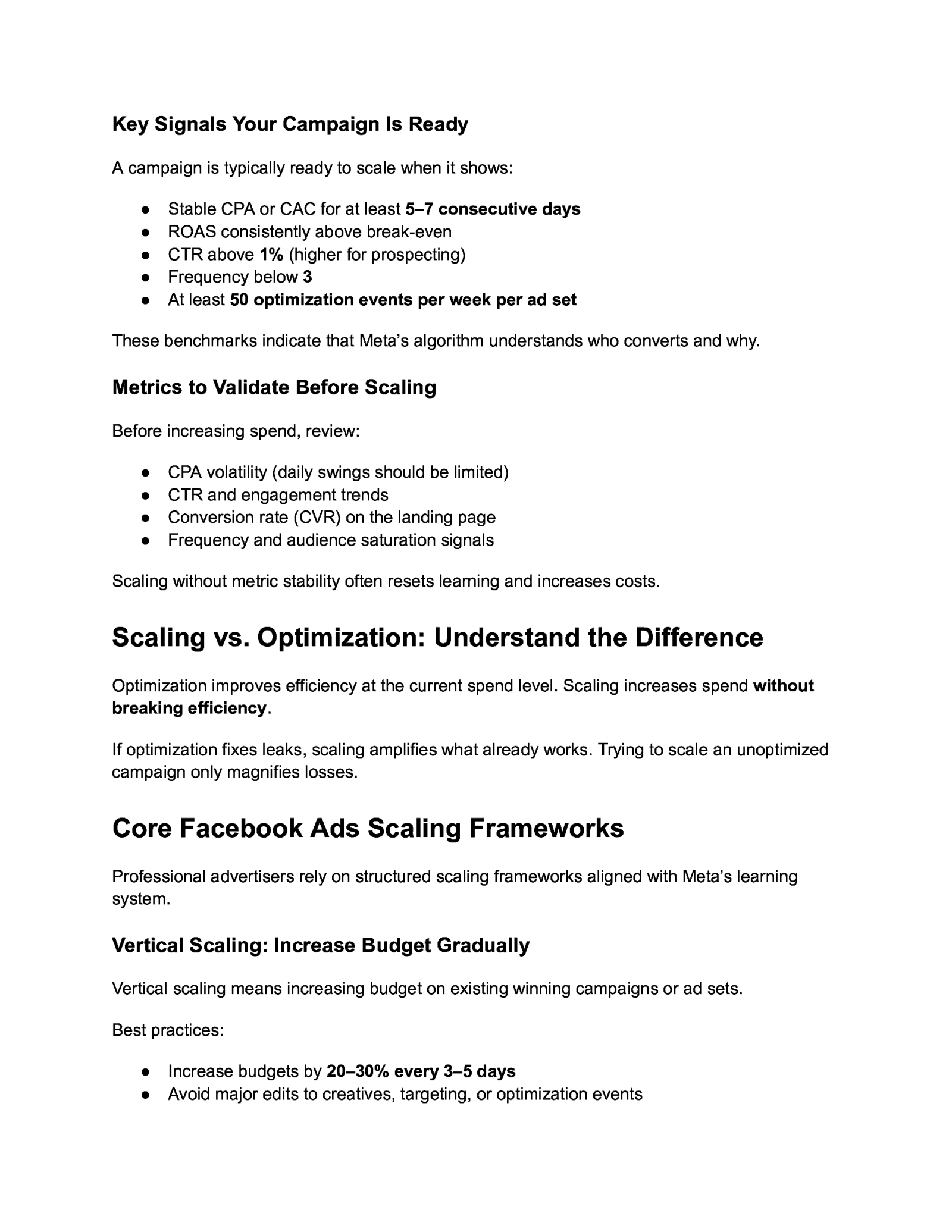
Key Signals Your Campaign Is Ready A campaign is typically ready to scale when it shows: ●​ ●​ ●​ ●​ ●​ Stable CPA or CAC for at least 5–7 consecutive days ROAS consistently above break-even CTR above 1% (higher for prospecting) Frequency below 3 At least 50 optimization events per week per ad set These benchmarks indicate that Meta’s algorithm understands who converts and why. Metrics to Validate Before Scaling Before increasing spend, review: ●​ ●​ ●​ ●​ CPA volatility (daily swings should be limited) CTR and engagement trends Conversion rate (CVR) on the landing page Frequency and audience saturation signals Scaling without metric stability often resets learning and increases costs. Scaling vs. Optimization: Understand the Difference Optimization improves efficiency at the current spend level. Scaling increases spend without breaking efficiency. If optimization fixes leaks, scaling amplifies what already works. Trying to scale an unoptimized campaign only magnifies losses. Core Facebook Ads Scaling Frameworks Professional advertisers rely on structured scaling frameworks aligned with Meta’s learning system. Vertical Scaling: Increase Budget Gradually Vertical scaling means increasing budget on existing winning campaigns or ad sets. Best practices: ●​ Increase budgets by 20–30% every 3–5 days ●​ Avoid major edits to creatives, targeting, or optimization events

Slide 3

Slide 3

●​ Use Campaign Budget Optimization (CBO) when ad sets perform similarly This method preserves algorithmic learning while increasing volume. Horizontal Scaling: Expand Reach Strategically Horizontal scaling finds new demand pools instead of pushing harder on the same audience. Effective horizontal methods include: Lookalike Expansion​ Test broader ranges (1–3%, 3–5%, even 5–10%) and different source events such as Add to Cart or Initiate Checkout. Broad Targeting​ In 2025, broad targeting often outperforms interest stacking. With strong creative and reliable conversion data, Meta’s AI frequently finds buyers more efficiently than manual targeting. Creative Angle Expansion​ Duplicate winning ad sets and test new messaging angles: UGC, problem-solution hooks, benefit-driven copy, or social proof formats. Geographic Expansion​ Expand to similar markets (US → CA, UK, AU) with localized creatives and pricing. Hybrid Scaling: The Sustainable Model Most profitable brands use a hybrid approach: 1.​ 2.​ 3.​ 4.​ Scale vertically until CPA or frequency rises Shift to horizontal scaling to find fresh audiences Validate new ad sets Scale those vertically again This cycle prevents saturation while maintaining momentum. Common Mistakes That Break Scaling Increasing Budgets Too Aggressively Large budget jumps shock the algorithm and often reset learning. Overnight 2x–5x increases usually cause CPA spikes. Ignoring Audience Overlap

Slide 4

Slide 4

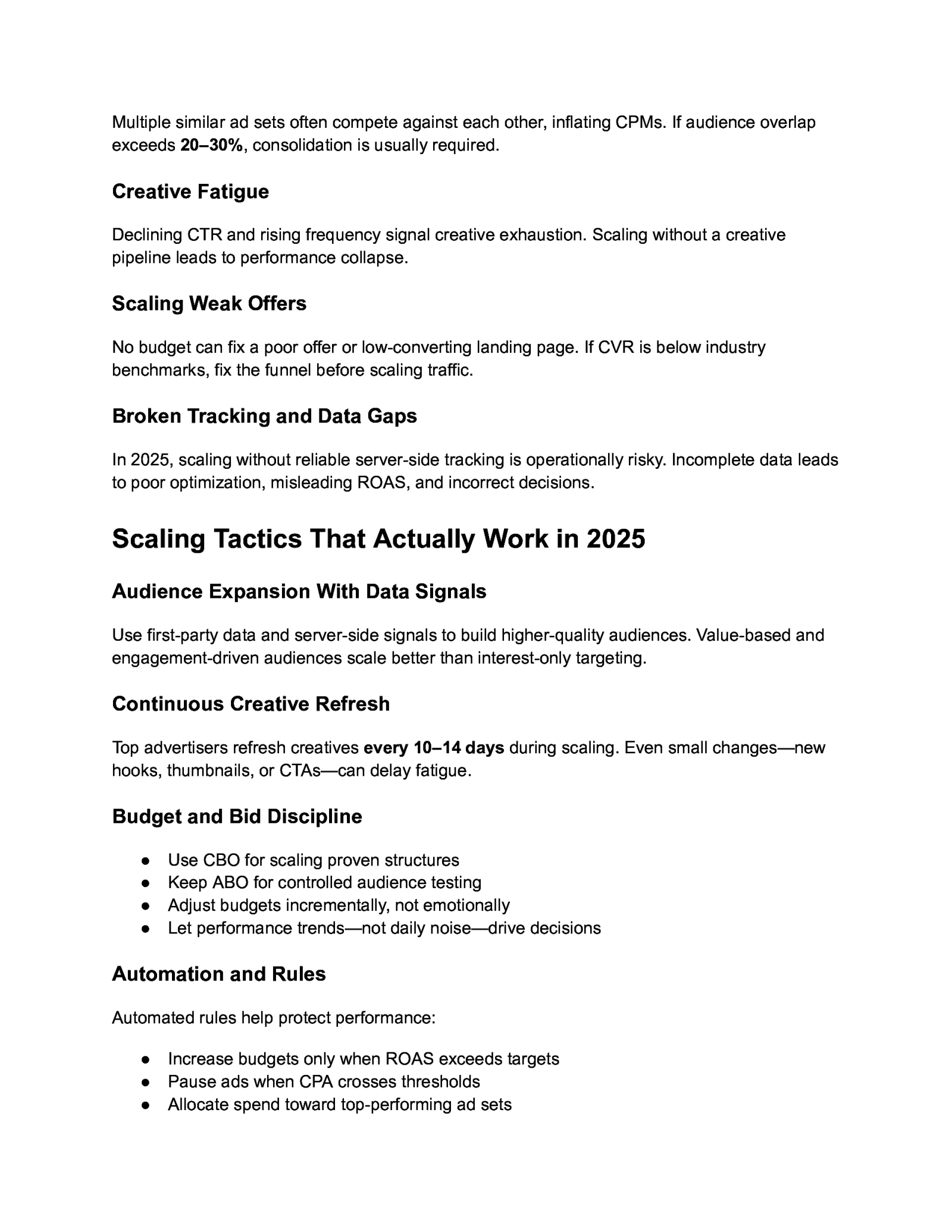
Multiple similar ad sets often compete against each other, inflating CPMs. If audience overlap exceeds 20–30%, consolidation is usually required. Creative Fatigue Declining CTR and rising frequency signal creative exhaustion. Scaling without a creative pipeline leads to performance collapse. Scaling Weak Offers No budget can fix a poor offer or low-converting landing page. If CVR is below industry benchmarks, fix the funnel before scaling traffic. Broken Tracking and Data Gaps In 2025, scaling without reliable server-side tracking is operationally risky. Incomplete data leads to poor optimization, misleading ROAS, and incorrect decisions. Scaling Tactics That Actually Work in 2025 Audience Expansion With Data Signals Use first-party data and server-side signals to build higher-quality audiences. Value-based and engagement-driven audiences scale better than interest-only targeting. Continuous Creative Refresh Top advertisers refresh creatives every 10–14 days during scaling. Even small changes—new hooks, thumbnails, or CTAs—can delay fatigue. Budget and Bid Discipline ●​ ●​ ●​ ●​ Use CBO for scaling proven structures Keep ABO for controlled audience testing Adjust budgets incrementally, not emotionally Let performance trends—not daily noise—drive decisions Automation and Rules Automated rules help protect performance: ●​ Increase budgets only when ROAS exceeds targets ●​ Pause ads when CPA crosses thresholds ●​ Allocate spend toward top-performing ad sets

Slide 5

Slide 5

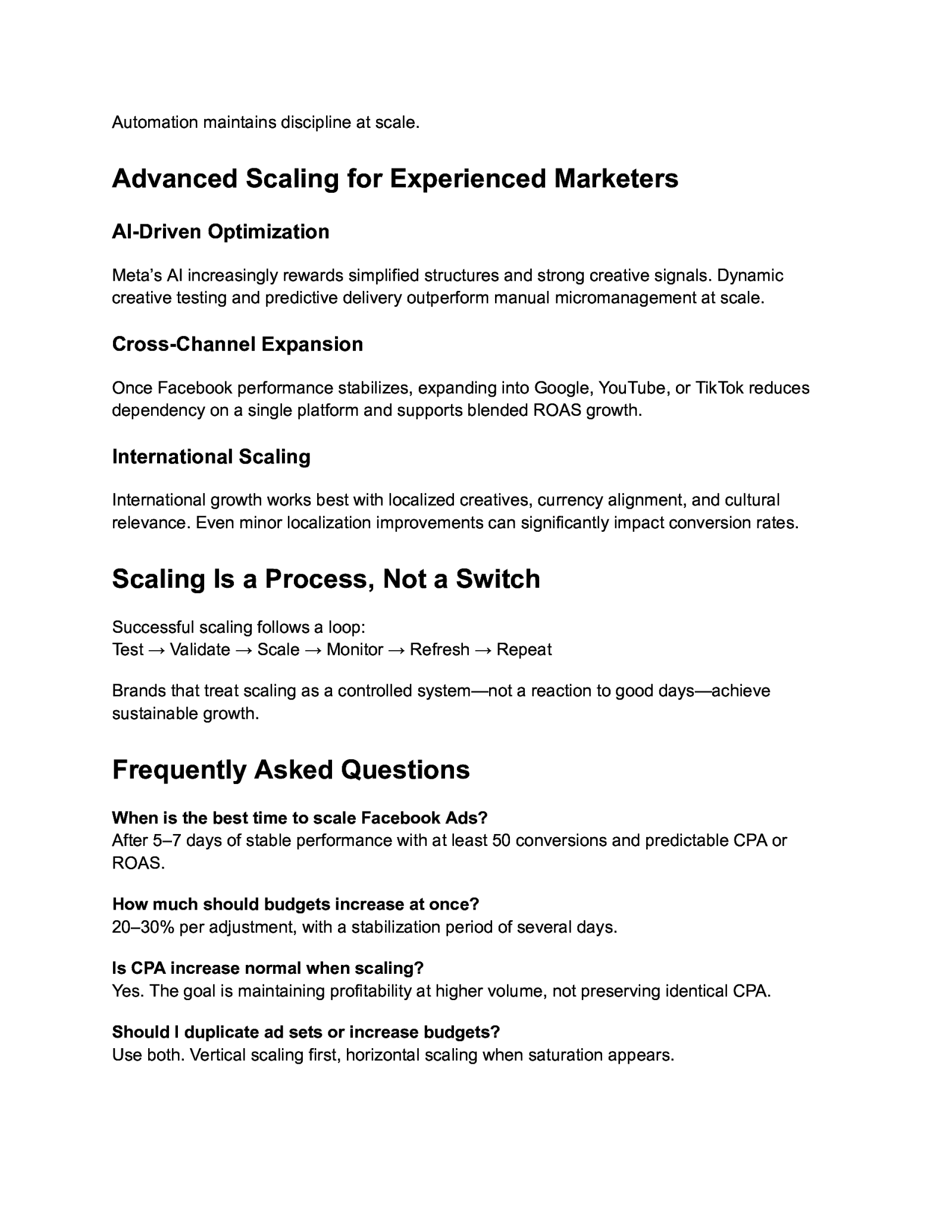
Automation maintains discipline at scale. Advanced Scaling for Experienced Marketers AI-Driven Optimization Meta’s AI increasingly rewards simplified structures and strong creative signals. Dynamic creative testing and predictive delivery outperform manual micromanagement at scale. Cross-Channel Expansion Once Facebook performance stabilizes, expanding into Google, YouTube, or TikTok reduces dependency on a single platform and supports blended ROAS growth. International Scaling International growth works best with localized creatives, currency alignment, and cultural relevance. Even minor localization improvements can significantly impact conversion rates. Scaling Is a Process, Not a Switch Successful scaling follows a loop:​ Test → Validate → Scale → Monitor → Refresh → Repeat Brands that treat scaling as a controlled system—not a reaction to good days—achieve sustainable growth. Frequently Asked Questions When is the best time to scale Facebook Ads?​ After 5–7 days of stable performance with at least 50 conversions and predictable CPA or ROAS. How much should budgets increase at once?​ 20–30% per adjustment, with a stabilization period of several days. Is CPA increase normal when scaling?​ Yes. The goal is maintaining profitability at higher volume, not preserving identical CPA. Should I duplicate ad sets or increase budgets?​ Use both. Vertical scaling first, horizontal scaling when saturation appears.

Slide 6

Slide 6

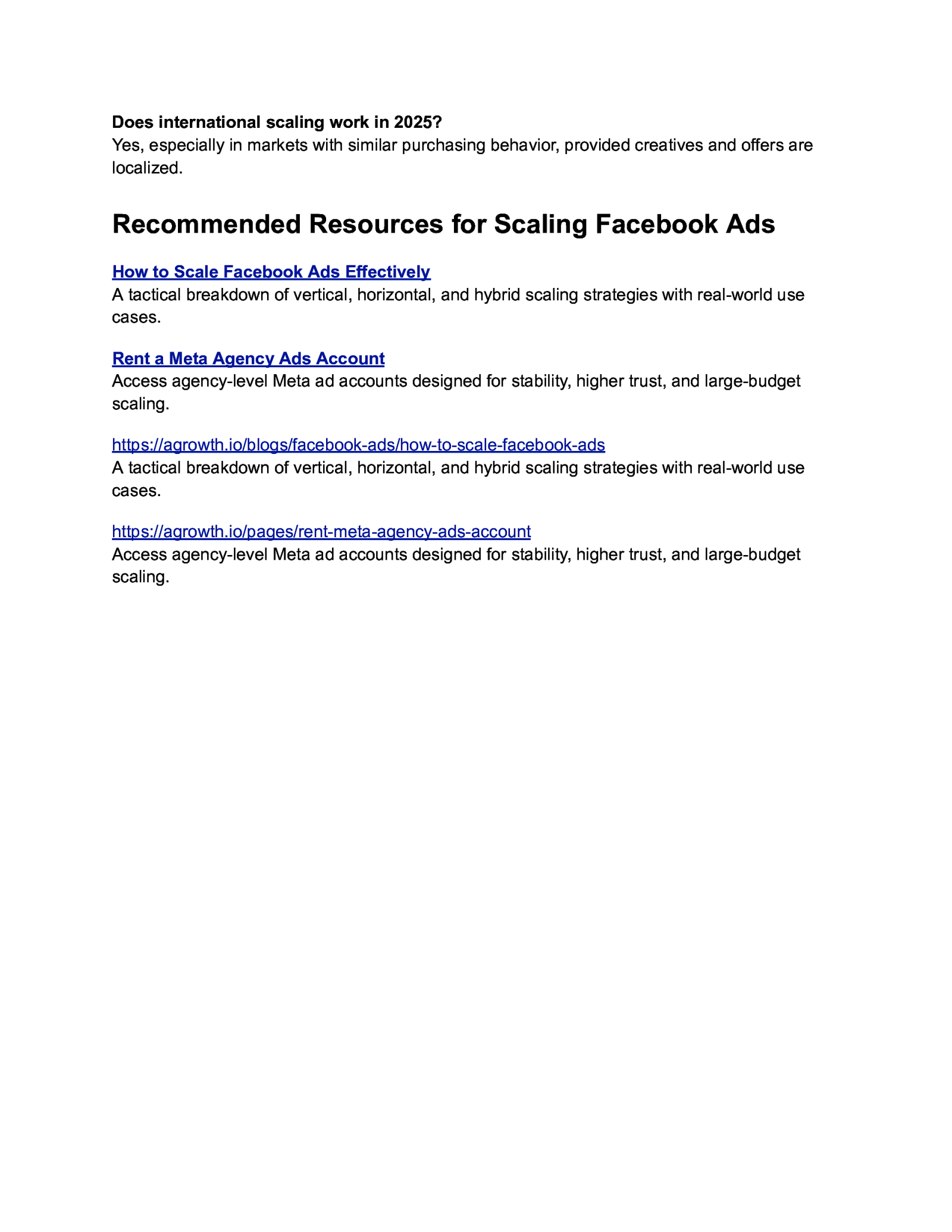
Does international scaling work in 2025?​ Yes, especially in markets with similar purchasing behavior, provided creatives and offers are localized. Recommended Resources for Scaling Facebook Ads How to Scale Facebook Ads Effectively​ A tactical breakdown of vertical, horizontal, and hybrid scaling strategies with real-world use cases. Rent a Meta Agency Ads Account​ Access agency-level Meta ad accounts designed for stability, higher trust, and large-budget scaling. https://agrowth.io/blogs/facebook-ads/how-to-scale-facebook-ads​ A tactical breakdown of vertical, horizontal, and hybrid scaling strategies with real-world use cases. https://agrowth.io/pages/rent-meta-agency-ads-account​ Access agency-level Meta ad accounts designed for stability, higher trust, and large-budget scaling.

Slide 7

Slide 7

1️⃣ Long-form Article (~3000 characters) Scaling Facebook Ads in 2025 is no longer about turning the budget knob to the right. With higher CPMs, stricter privacy rules, and AI-driven delivery, profitable scaling now requires discipline, clean data, and repeatable systems. Many advertisers fail at scaling because they confuse optimization with expansion. Optimization improves efficiency at the current spend level. Scaling increases spend while keeping CPA and ROAS within profitable ranges. If your campaign is unstable, scaling will only amplify losses. Before scaling, validate performance stability. Winning campaigns typically show consistent CPA for 5–7 days, CTR above 1%, frequency under 3, and at least 50 weekly conversions per ad set. These signals tell Meta’s algorithm who converts and why. There are three proven scaling frameworks.​ Vertical scaling increases budget gradually on winning campaigns, usually in 20–30% increments every few days. This allows the algorithm to adapt without resetting learning.​ Horizontal scaling expands reach by duplicating winning ad sets and testing new audiences, creatives, or geographies. Lookalike expansion, broad targeting, and new creative angles are common tactics.​ Hybrid scaling combines both methods—scaling vertically until saturation appears, then shifting horizontally to find fresh demand. Most scaling failures come from predictable mistakes: increasing budgets too fast, ignoring audience overlap, letting creatives fatigue, or scaling weak offers. Another critical issue is poor tracking. Without reliable server-side data, Meta’s optimization signals degrade, making scaling decisions unreliable. Successful advertisers in 2025 focus on creative velocity, incremental budget growth, and automation. They refresh creatives proactively, use rules to protect performance, and scale only what has already proven profitable. Scaling is not a single action. It’s a process built on testing, validation, controlled expansion, and continuous monitoring. 🔗 Read the full scaling framework here:​ https://agrowth.io/blogs/facebook-ads/how-to-scale-facebook-ads #FacebookAds #ScalingFacebookAds #PaidSocial #MediaBuying #PerformanceMarketing #DigitalAdvertising #EcommerceGrowth 2️⃣ Mid-length Version (~1000 characters)
Slide 8

Slide 8

Scaling Facebook Ads isn’t about spending more—it’s about expanding what already works without breaking performance. Before scaling, campaigns must show stability: consistent CPA for several days, CTR above 1%, low frequency, and enough conversion volume for Meta to optimize effectively. Scaling too early resets learning and increases costs. There are three main approaches. Vertical scaling increases budgets gradually on winning campaigns. Horizontal scaling expands reach through new audiences, creatives, or markets. The most reliable approach is hybrid scaling—combining both to avoid saturation. Most advertisers fail by raising budgets too aggressively, reusing fatigued creatives, or scaling offers that don’t convert. In 2025, clean data and disciplined execution separate profitable scalers from the rest. Learn the full step-by-step framework here:​ https://agrowth.io/blogs/facebook-ads/how-to-scale-facebook-ads #FacebookAds #AdScaling #PaidMedia #GrowthMarketing #EcommerceAds #MarketingStrategy 3️⃣ Short Version (~300 characters) Scaling Facebook Ads in 2025 isn’t about bigger budgets—it’s about stable performance, clean data, and disciplined execution. Learn when to scale, how to avoid algorithm resets, and which frameworks actually work. 👉 https://agrowth.io/blogs/facebook-ads/how-to-scale-facebook-ads #FacebookAds #ScalingAds #PaidSocial #PerformanceMarketing #MediaBuying 4️⃣ Social Post – Short (Snackable, with tags) Scaling Facebook Ads too early is the fastest way to kill ROAS. If your CPA isn’t stable, creatives aren’t proven, and data isn’t clean—scaling will only amplify losses. 👇 Here’s a practical framework to scale safely in 2025 ​ https://agrowth.io/blogs/facebook-ads/how-to-scale-facebook-ads

Slide 9

Slide 9

#FacebookAds #AdScaling #PaidMedia #GrowthHacking #EcommerceMarketing 5️⃣ Social Post – Long (Storytelling + Helpful Content) A common mistake I see when advertisers try to scale Facebook Ads is confusing a “good day” with a scalable system. One strong ROAS spike doesn’t mean the campaign is ready. Real scaling starts only when performance is stable—CPA holds steady, creatives keep CTR above 1%, and Meta has enough conversion data to optimize confidently. In 2025, scaling isn’t about pushing budgets harder. It’s about respecting the algorithm. Gradual budget increases, fresh creative angles, and smart audience expansion outperform aggressive spend every time. The advertisers who scale profitably follow a repeatable process:​ optimize first → validate stability → scale incrementally → monitor → refresh creatives → repeat. If you’re planning to grow spend without sacrificing ROAS, this breakdown will save you a lot of wasted budget:​ https://agrowth.io/blogs/facebook-ads/how-to-scale-facebook-ads #FacebookAds #ScalingFacebookAds #PaidSocial #MediaBuying #EcommerceGrowth #PerformanceMarketing