Advancing the Biodiversity Economy in South Africa Preshanthie Naicker-Manick Project Manager: UNDP/GEF 6 Bioprospecting/Biotrade Value Chains NCA Forum 7 August 2024

A presentation at Advancing the Biodiversity Economy in South Africa in January 2026 in by Peter Van deb Broecke
Advancing the Biodiversity Economy in South Africa Preshanthie Naicker-Manick Project Manager: UNDP/GEF 6 Bioprospecting/Biotrade Value Chains NCA Forum 7 August 2024
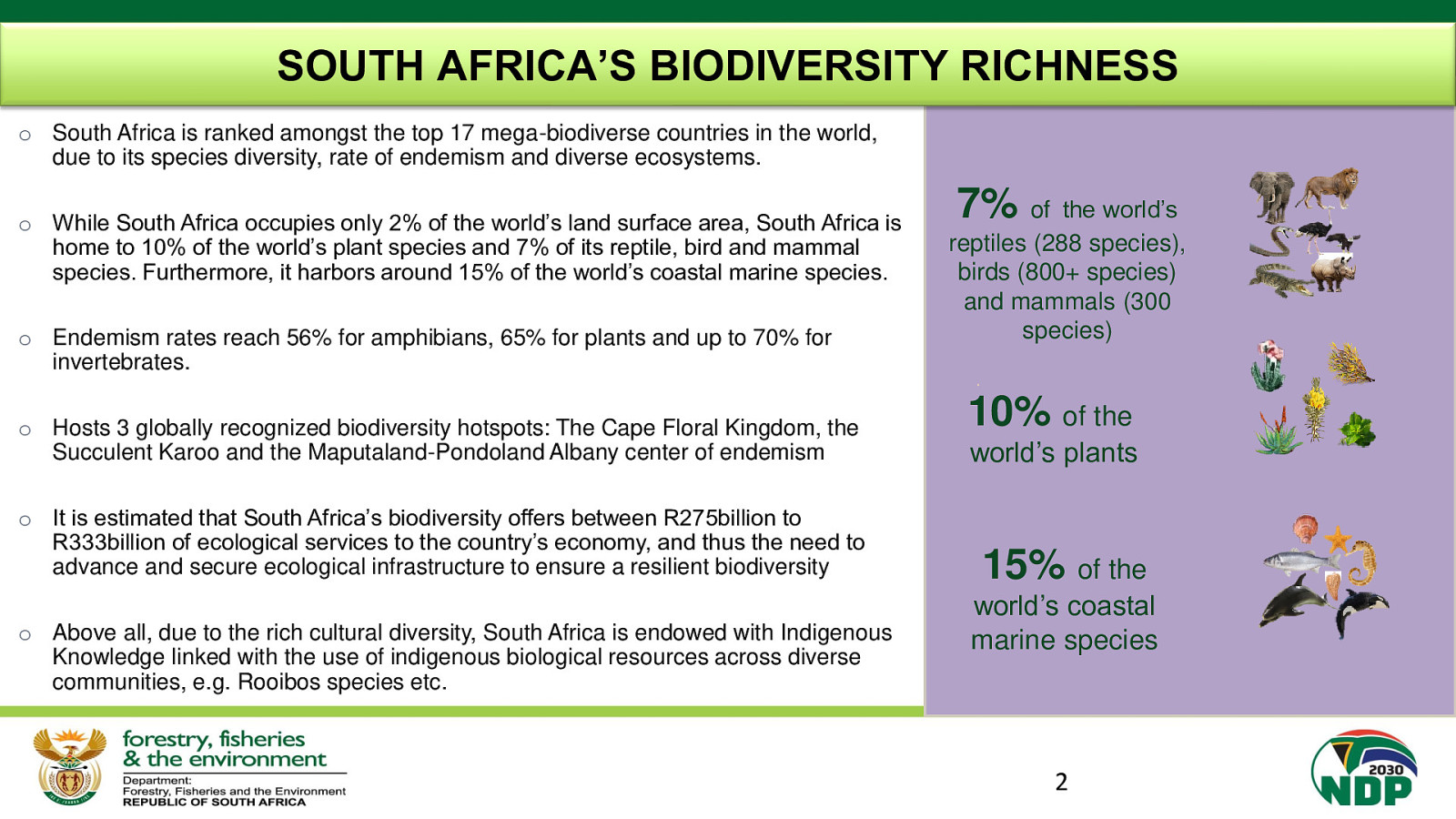
SOUTH AFRICA’S BIODIVERSITY RICHNESS o South Africa is ranked amongst the top 17 mega-biodiverse countries in the world, due to its species diversity, rate of endemism and diverse ecosystems. o While South Africa occupies only 2% of the world’s land surface area, South Africa is home to 10% of the world’s plant species and 7% of its reptile, bird and mammal species. Furthermore, it harbors around 15% of the world’s coastal marine species. o Endemism rates reach 56% for amphibians, 65% for plants and up to 70% for invertebrates. o Hosts 3 globally recognized biodiversity hotspots: The Cape Floral Kingdom, the Succulent Karoo and the Maputaland-Pondoland Albany center of endemism o It is estimated that South Africa’s biodiversity offers between R275billion to R333billion of ecological services to the country’s economy, and thus the need to advance and secure ecological infrastructure to ensure a resilient biodiversity o Above all, due to the rich cultural diversity, South Africa is endowed with Indigenous Knowledge linked with the use of indigenous biological resources across diverse communities, e.g. Rooibos species etc. 7% of the world’s reptiles (288 species), birds (800+ species) and mammals (300 species) 10% of the world’s plants 15% of the world’s coastal marine species 2
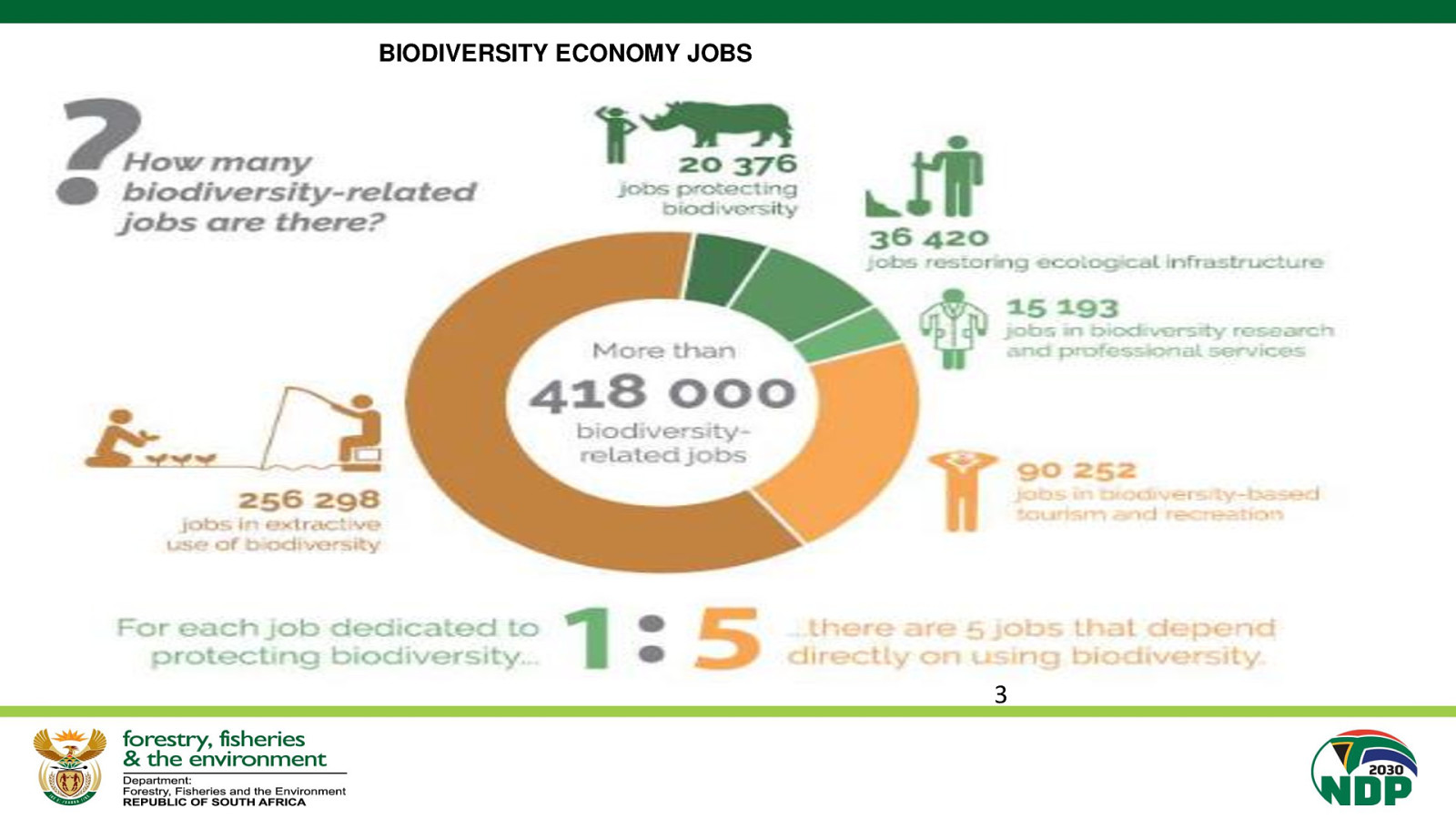
BIODIVERSITY ECONOMY JOBS 3
HOW IS SOUTH AFRICA ADVANCING THE BIODIVERSITY ECONOMY?
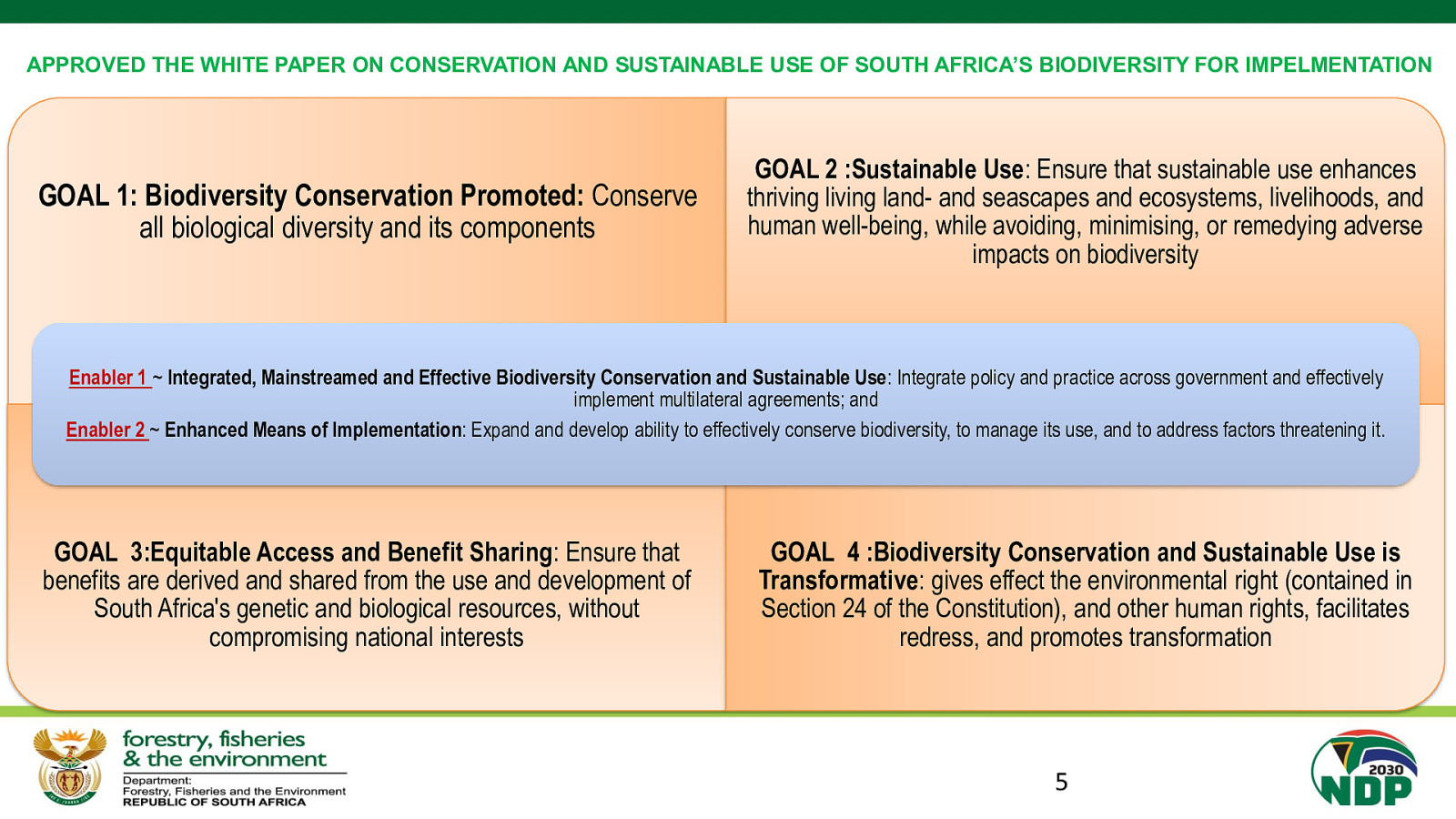
APPROVED THE WHITE PAPER ON CONSERVATION AND SUSTAINABLE USE OF SOUTH AFRICA’S BIODIVERSITY FOR IMPELMENTATION GOAL 1: Biodiversity Conservation Promoted: Conserve all biological diversity and its components GOAL 2 :Sustainable Use: Ensure that sustainable use enhances thriving living land- and seascapes and ecosystems, livelihoods, and human well-being, while avoiding, minimising, or remedying adverse impacts on biodiversity Enabler 1 ~ Integrated, Mainstreamed and Effective Biodiversity Conservation and Sustainable Use: Integrate policy and practice across government and effectively implement multilateral agreements; and Enabler 2 ~ Enhanced Means of Implementation: Expand and develop ability to effectively conserve biodiversity, to manage its use, and to address factors threatening it. GOAL 3:Equitable Access and Benefit Sharing: Ensure that benefits are derived and shared from the use and development of South Africa’s genetic and biological resources, without compromising national interests GOAL 4 :Biodiversity Conservation and Sustainable Use is Transformative: gives effect the environmental right (contained in Section 24 of the Constitution), and other human rights, facilitates redress, and promotes transformation 5
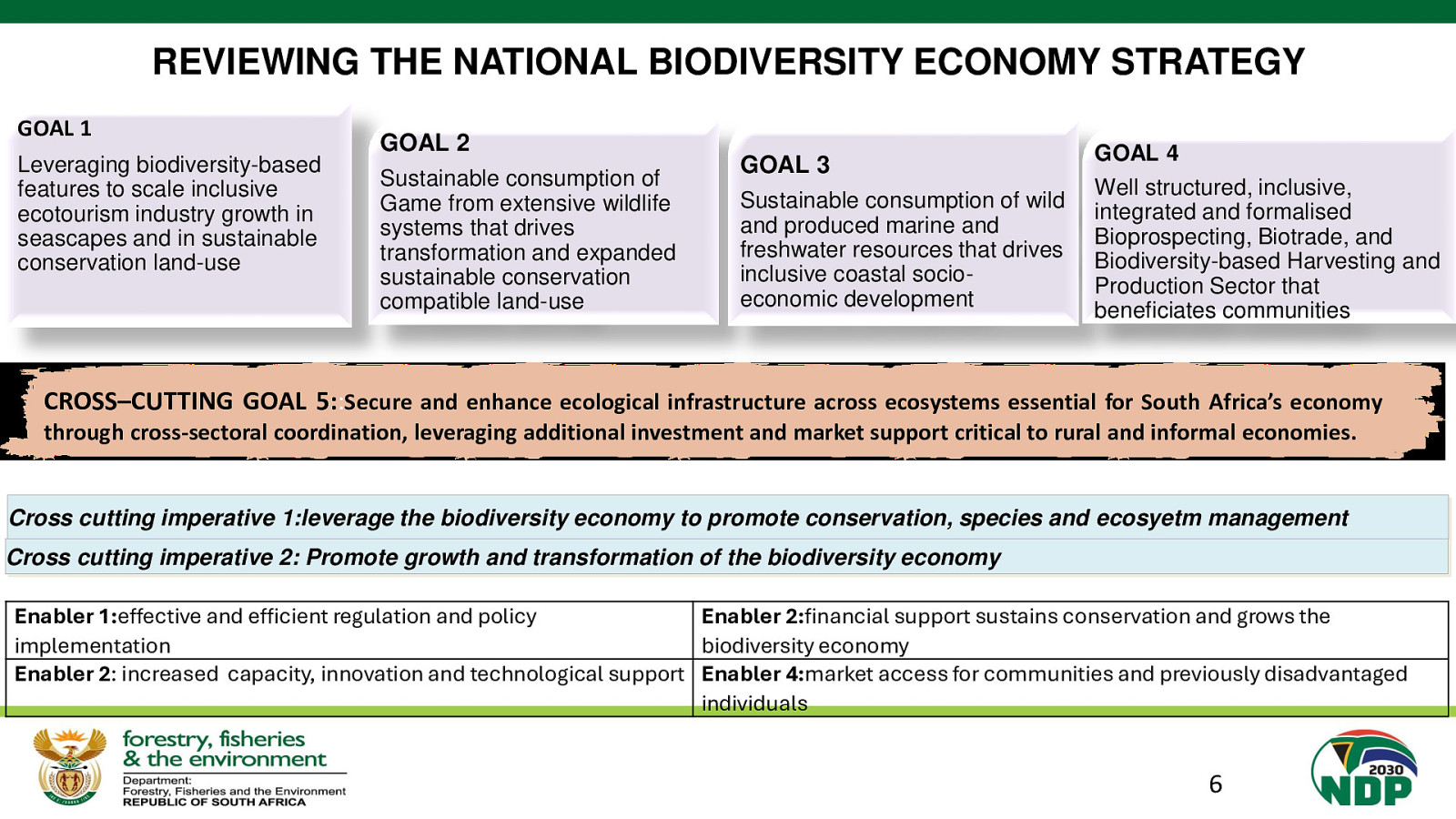
REVIEWING THE NATIONAL BIODIVERSITY ECONOMY STRATEGY GOAL 1 Leveraging biodiversity-based features to scale inclusive ecotourism industry growth in seascapes and in sustainable conservation land-use GOAL 2 Sustainable consumption of Game from extensive wildlife systems that drives transformation and expanded sustainable conservation compatible land-use GOAL 3 Sustainable consumption of wild and produced marine and freshwater resources that drives inclusive coastal socioeconomic development GOAL 4 Well structured, inclusive, integrated and formalised Bioprospecting, Biotrade, and Biodiversity-based Harvesting and Production Sector that beneficiates communities CROSS–CUTTING GOAL 5::Secure and enhance ecological infrastructure across ecosystems essential for South Africa’s economy through cross-sectoral coordination, leveraging additional investment and market support critical to rural and informal economies. Cross cutting imperative 1:leverage the biodiversity economy to promote conservation, species and ecosyetm management Cross cutting imperative 2: Promote growth and transformation of the biodiversity economy Enabler 1:effective and efficient regulation and policy Enabler 2:financial support sustains conservation and grows the implementation biodiversity economy Enabler 2: increased capacity, innovation and technological support Enabler 4:market access for communities and previously disadvantaged individuals 6
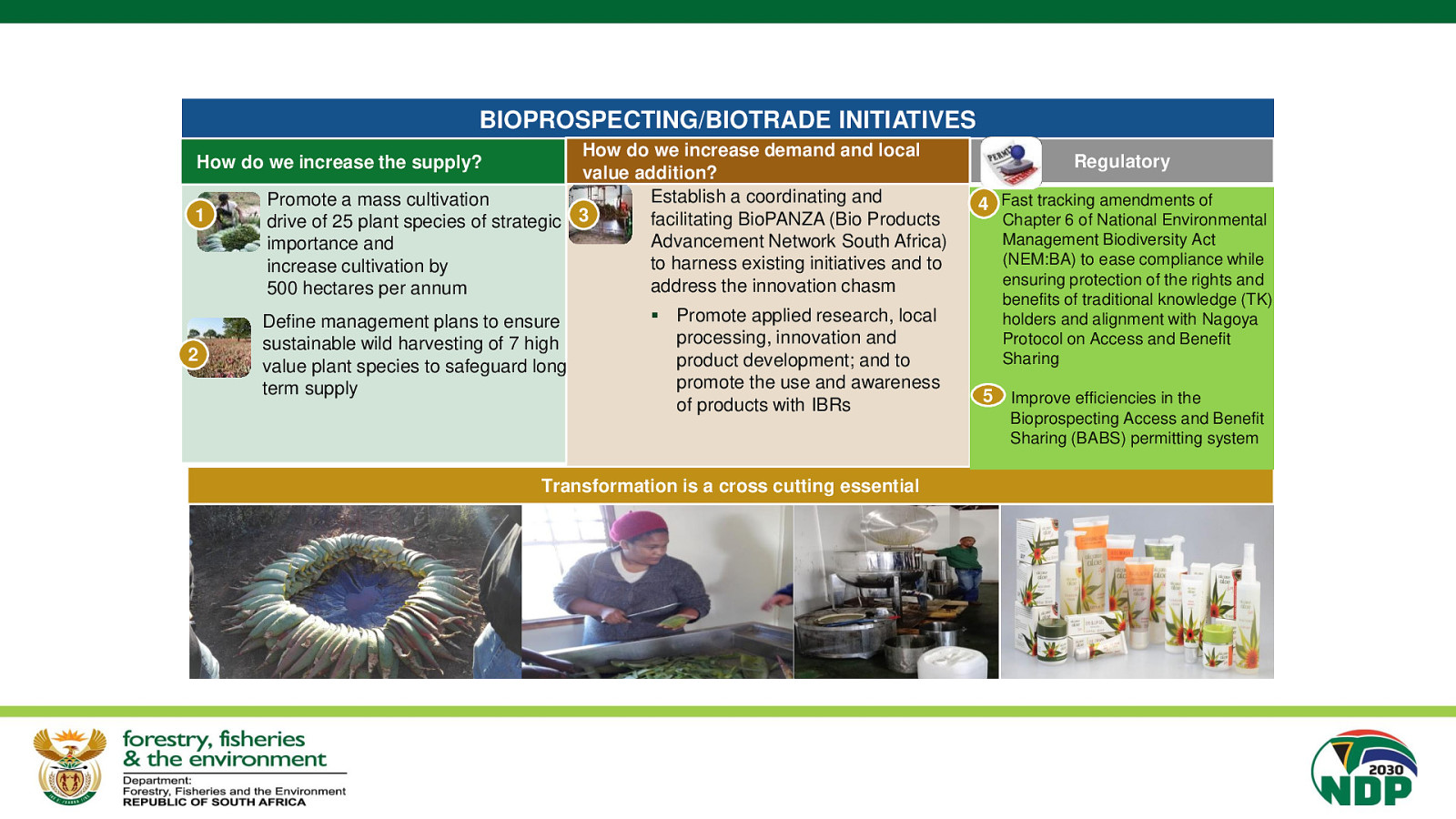
BIOPROSPECTING/BIOTRADE INITIATIVES How do we increase demand and local value addition? Establish a coordinating and Promote a mass cultivation 3 facilitating BioPANZA (Bio Products drive of 25 plant species of strategic Advancement Network South Africa) importance and to harness existing initiatives and to increase cultivation by address the innovation chasm 500 hectares per annum How do we increase the supply? 1 2 Define management plans to ensure sustainable wild harvesting of 7 high value plant species to safeguard long term supply ▪ Promote applied research, local processing, innovation and product development; and to promote the use and awareness of products with IBRs Transformation is a cross cutting essential Regulatory 4 Fast tracking amendments of Chapter 6 of National Environmental Management Biodiversity Act (NEM:BA) to ease compliance while ensuring protection of the rights and benefits of traditional knowledge (TK) holders and alignment with Nagoya Protocol on Access and Benefit Sharing 5 Improve efficiencies in the Bioprospecting Access and Benefit Sharing (BABS) permitting system
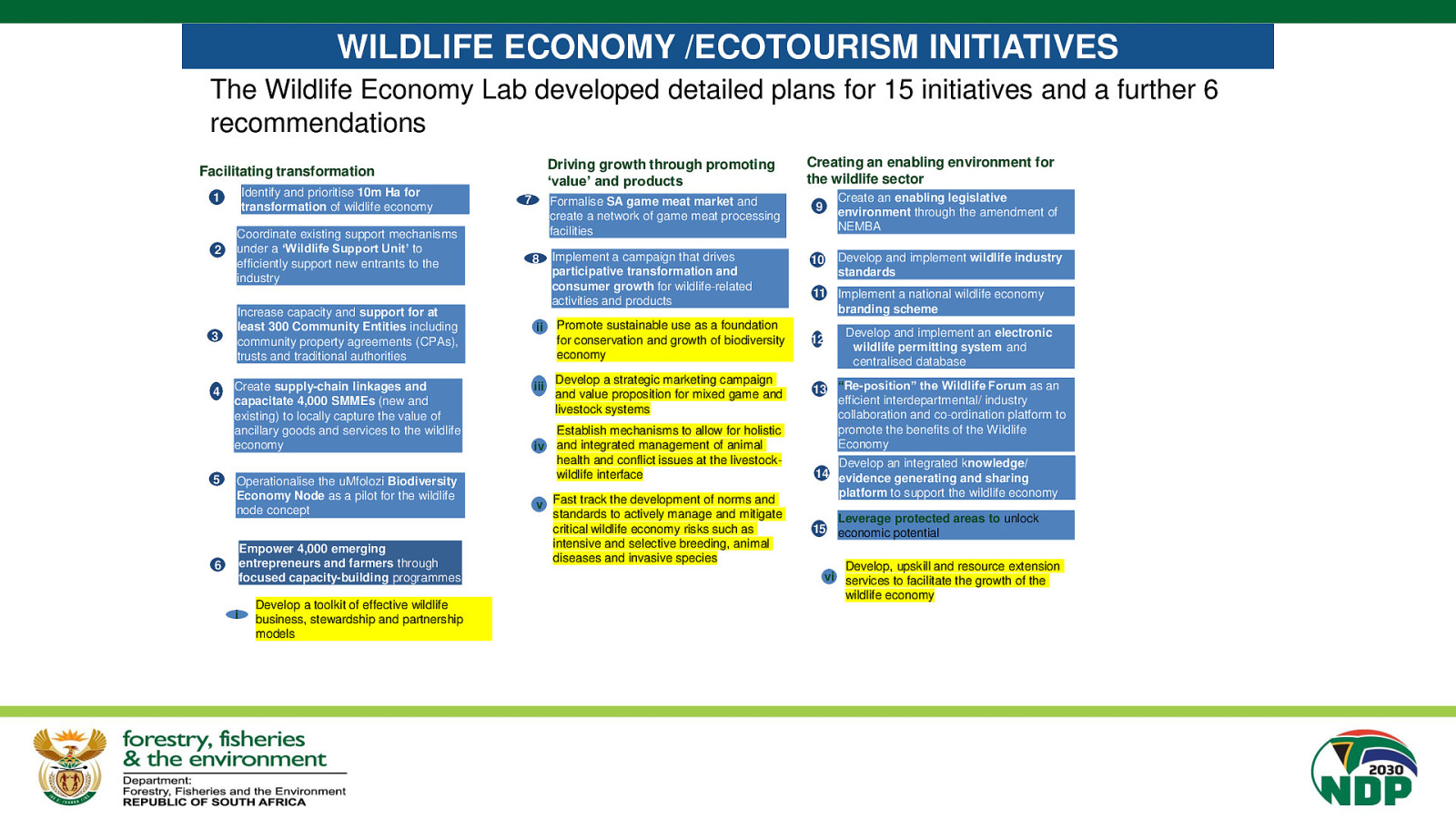
WILDLIFE ECONOMY /ECOTOURISM INITIATIVES The Wildlife Economy Lab developed detailed plans for 15 initiatives and a further 6 recommendations Driving growth through promoting ‘value’ and products Facilitating transformation Identify and prioritise 10m Ha for transformation of wildlife economy 1 2 Coordinate existing support mechanisms under a ‘Wildlife Support Unit’ to efficiently support new entrants to the industry 3 Increase capacity and support for at least 300 Community Entities including community property agreements (CPAs), trusts and traditional authorities 4 5 Create supply-chain linkages and capacitate 4,000 SMMEs (new and existing) to locally capture the value of ancillary goods and services to the wildlife economy Operationalise the uMfolozi Biodiversity Economy Node as a pilot for the wildlife node concept Empower 4,000 emerging entrepreneurs and farmers through focused capacity-building programmes 6 i Develop a toolkit of effective wildlife business, stewardship and partnership models 7 Formalise SA game meat market and create a network of game meat processing facilities 8 ii iii iv Implement a campaign that drives participative transformation and consumer growth for wildlife-related activities and products Promote sustainable use as a foundation for conservation and growth of biodiversity economy Develop a strategic marketing campaign and value proposition for mixed game and livestock systems Establish mechanisms to allow for holistic and integrated management of animal health and conflict issues at the livestockwildlife interface v Fast track the development of norms and standards to actively manage and mitigate critical wildlife economy risks such as intensive and selective breeding, animal diseases and invasive species Creating an enabling environment for the wildlife sector 9 Create an enabling legislative environment through the amendment of NEMBA 10 Develop and implement wildlife industry standards 11 Implement a national wildlife economy branding scheme 12 Develop and implement an electronic wildlife permitting system and centralised database 13 “Re-position” the Wildlife Forum as an efficient interdepartmental/ industry collaboration and co-ordination platform to promote the benefits of the Wildlife Economy Develop an integrated knowledge/ 14 evidence generating and sharing platform to support the wildlife economy Leverage protected areas to unlock 15 economic potential Develop, upskill and resource extension vi services to facilitate the growth of the wildlife economy
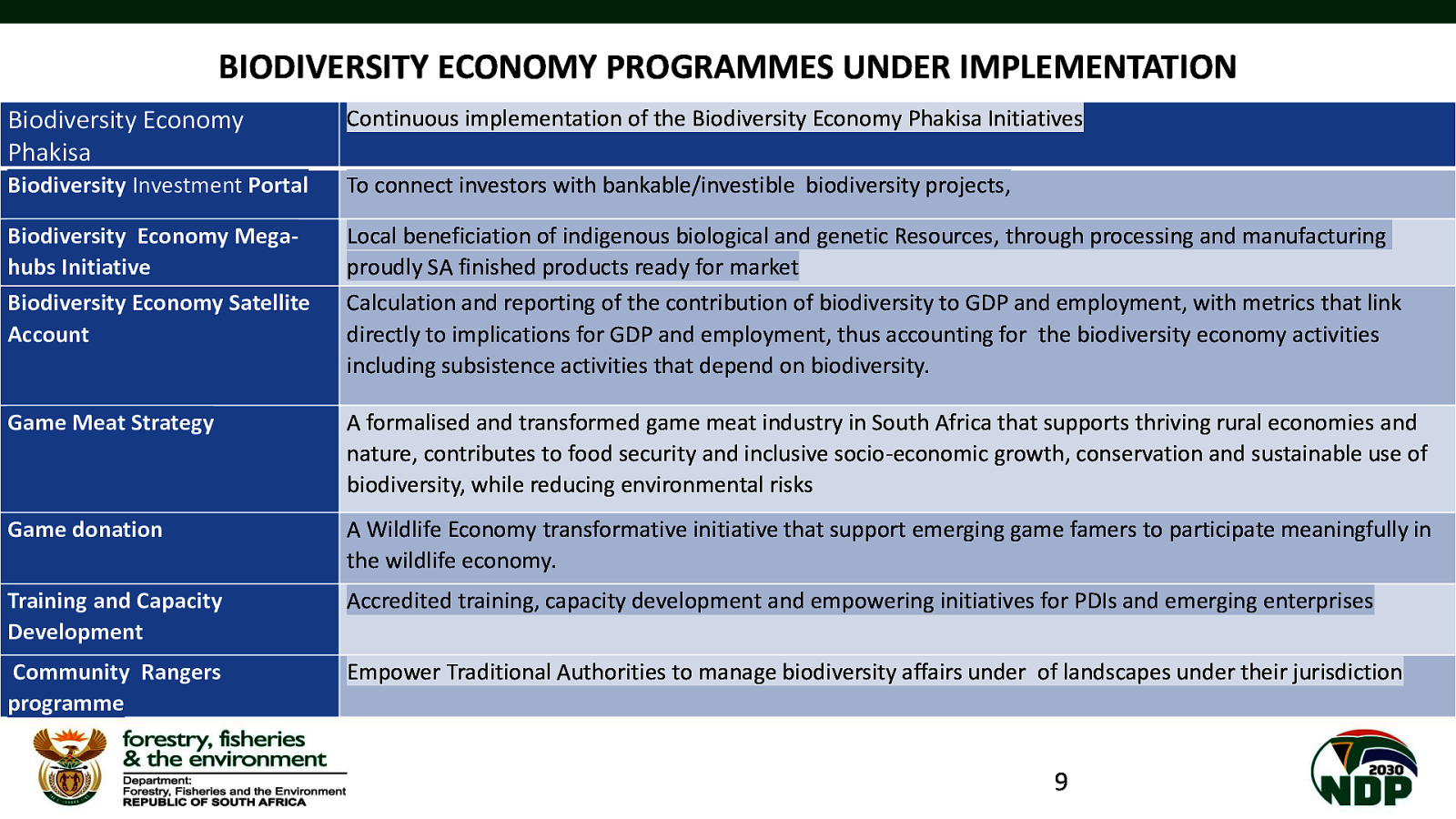
BIODIVERSITY ECONOMY PROGRAMMES UNDER IMPLEMENTATION Biodiversity Economy Phakisa Continuous implementation of the Biodiversity Economy Phakisa Initiatives Biodiversity Investment Portal To connect investors with bankable/investible biodiversity projects, Biodiversity Economy Megahubs Initiative Biodiversity Economy Satellite Account Local beneficiation of indigenous biological and genetic Resources, through processing and manufacturing proudly SA finished products ready for market Calculation and reporting of the contribution of biodiversity to GDP and employment, with metrics that link directly to implications for GDP and employment, thus accounting for the biodiversity economy activities including subsistence activities that depend on biodiversity. Game Meat Strategy A formalised and transformed game meat industry in South Africa that supports thriving rural economies and nature, contributes to food security and inclusive socio-economic growth, conservation and sustainable use of biodiversity, while reducing environmental risks Game donation A Wildlife Economy transformative initiative that support emerging game famers to participate meaningfully in the wildlife economy. Training and Capacity Development Accredited training, capacity development and empowering initiatives for PDIs and emerging enterprises Community Rangers programme Empower Traditional Authorities to manage biodiversity affairs under of landscapes under their jurisdiction 9
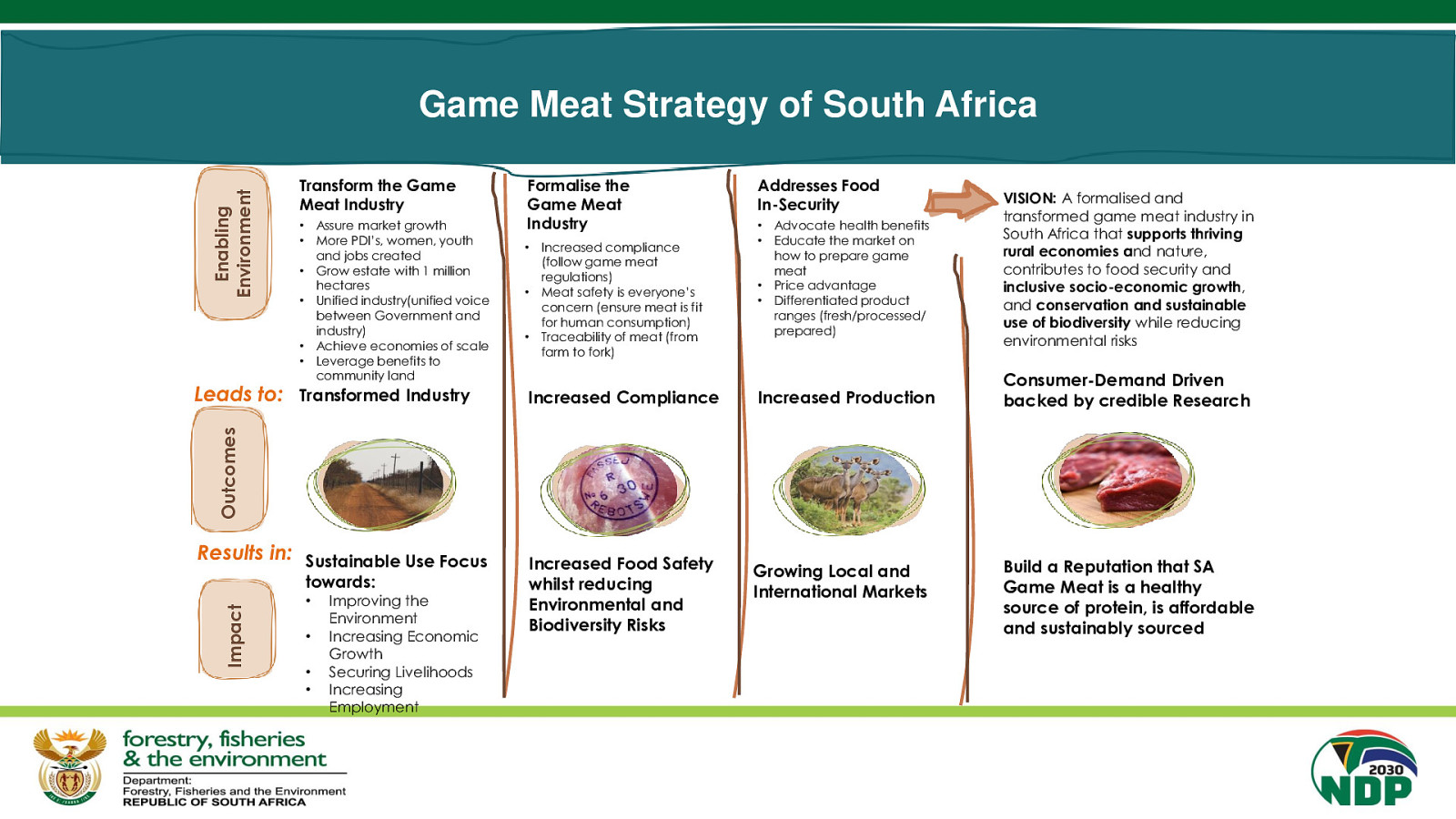
Enabling Environment Game Meat Strategy of South Africa Transform the Game Meat Industry • Assure market growth • More PDI’s, women, youth and jobs created • Grow estate with 1 million hectares • Unified industry(unified voice between Government and industry) • Achieve economies of scale • Leverage benefits to community land • Increased compliance (follow game meat regulations) • Meat safety is everyone’s concern (ensure meat is fit for human consumption) • Traceability of meat (from farm to fork) Addresses Food In-Security • Advocate health benefits • Educate the market on how to prepare game meat • Price advantage • Differentiated product ranges (fresh/processed/ prepared) Increased Compliance Increased Production Increased Food Safety whilst reducing Environmental and Biodiversity Risks Growing Local and International Markets VISION: A formalised and transformed game meat industry in South Africa that supports thriving rural economies and nature, contributes to food security and inclusive socio-economic growth, and conservation and sustainable use of biodiversity while reducing environmental risks Consumer-Demand Driven backed by credible Research Outcomes Leads to: Transformed Industry Formalise the Game Meat Industry Results in: Sustainable Use Focus Impact towards: • • • • Improving the Environment Increasing Economic Growth Securing Livelihoods Increasing Employment Build a Reputation that SA Game Meat is a healthy source of protein, is affordable and sustainably sourced
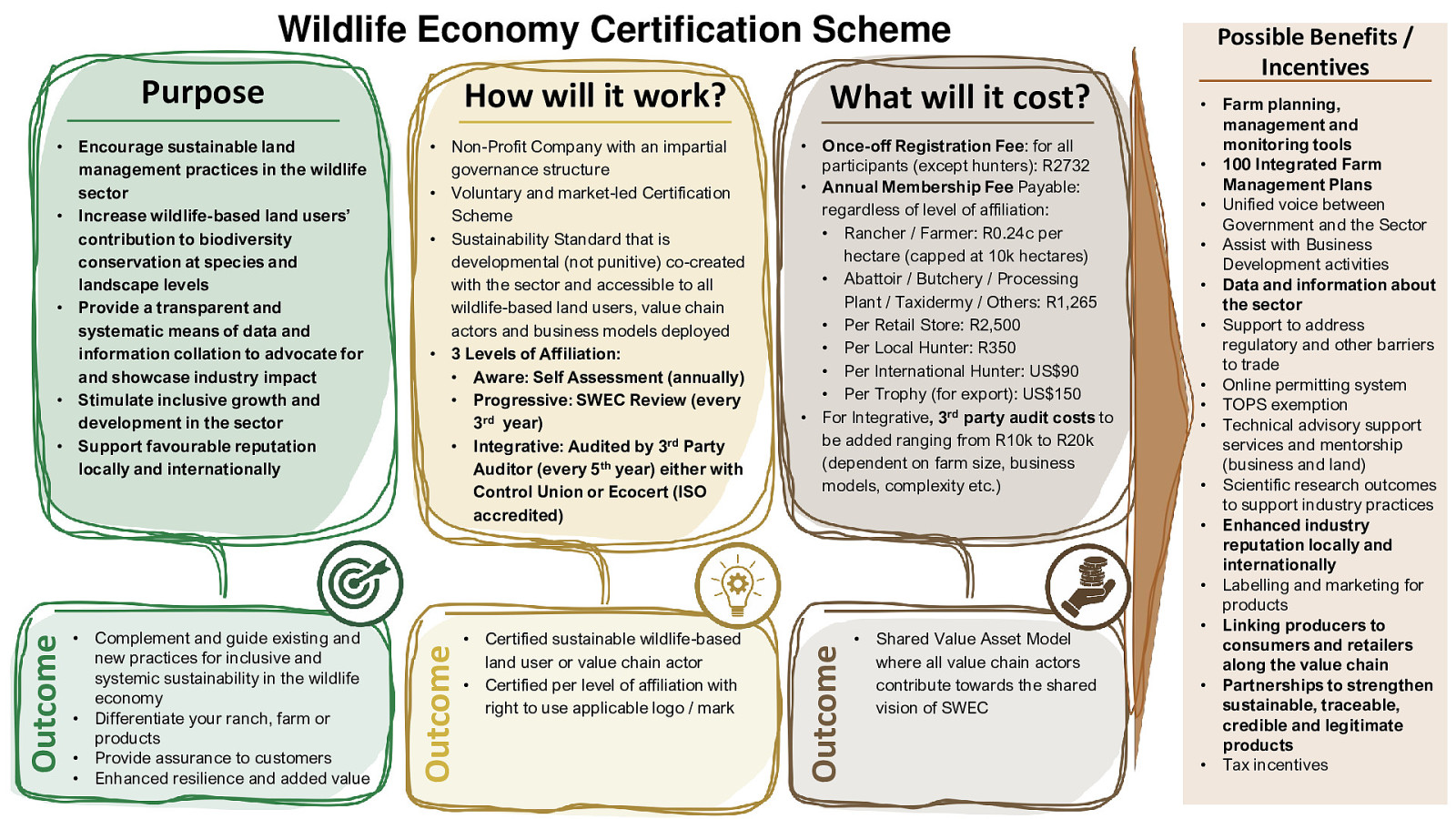
Wildlife Economy Certification Scheme How will it work? • Complement and guide existing and new practices for inclusive and systemic sustainability in the wildlife economy • Differentiate your ranch, farm or products • Provide assurance to customers • Enhanced resilience and added value • Certified sustainable wildlife-based land user or value chain actor • Certified per level of affiliation with right to use applicable logo / mark Outcome • Non-Profit Company with an impartial governance structure • Voluntary and market-led Certification Scheme • Sustainability Standard that is developmental (not punitive) co-created with the sector and accessible to all wildlife-based land users, value chain actors and business models deployed • 3 Levels of Affiliation: • Aware: Self Assessment (annually) • Progressive: SWEC Review (every 3rd year) • Integrative: Audited by 3rd Party Auditor (every 5th year) either with Control Union or Ecocert (ISO accredited) Outcome • Encourage sustainable land management practices in the wildlife sector • Increase wildlife-based land users’ contribution to biodiversity conservation at species and landscape levels • Provide a transparent and systematic means of data and information collation to advocate for and showcase industry impact • Stimulate inclusive growth and development in the sector • Support favourable reputation locally and internationally What will it cost? • Once-off Registration Fee: for all participants (except hunters): R2732 • Annual Membership Fee Payable: regardless of level of affiliation: • Rancher / Farmer: R0.24c per hectare (capped at 10k hectares) • Abattoir / Butchery / Processing Plant / Taxidermy / Others: R1,265 • Per Retail Store: R2,500 • Per Local Hunter: R350 • Per International Hunter: US$90 • Per Trophy (for export): US$150 • For Integrative, 3rd party audit costs to be added ranging from R10k to R20k (dependent on farm size, business models, complexity etc.) Outcome Purpose • Shared Value Asset Model where all value chain actors contribute towards the shared vision of SWEC Possible Benefits / Incentives • Farm planning, management and monitoring tools • 100 Integrated Farm Management Plans • Unified voice between Government and the Sector • Assist with Business Development activities • Data and information about the sector • Support to address regulatory and other barriers to trade • Online permitting system • TOPS exemption • Technical advisory support services and mentorship (business and land) • Scientific research outcomes to support industry practices • Enhanced industry reputation locally and internationally • Labelling and marketing for products • Linking producers to consumers and retailers along the value chain • Partnerships to strengthen sustainable, traceable, credible and legitimate products • Tax incentives
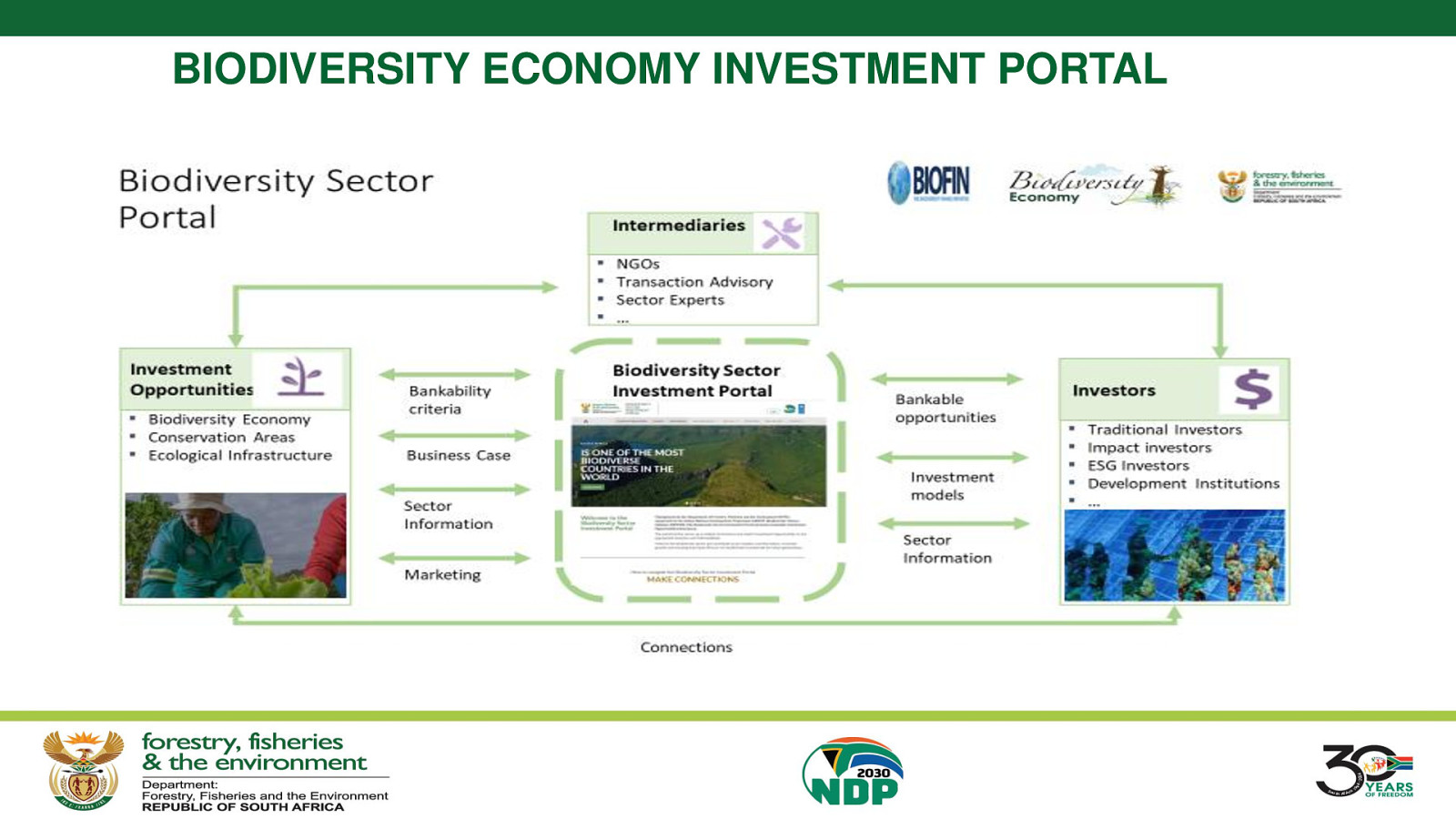
BIODIVERSITY ECONOMY INVESTMENT PORTAL
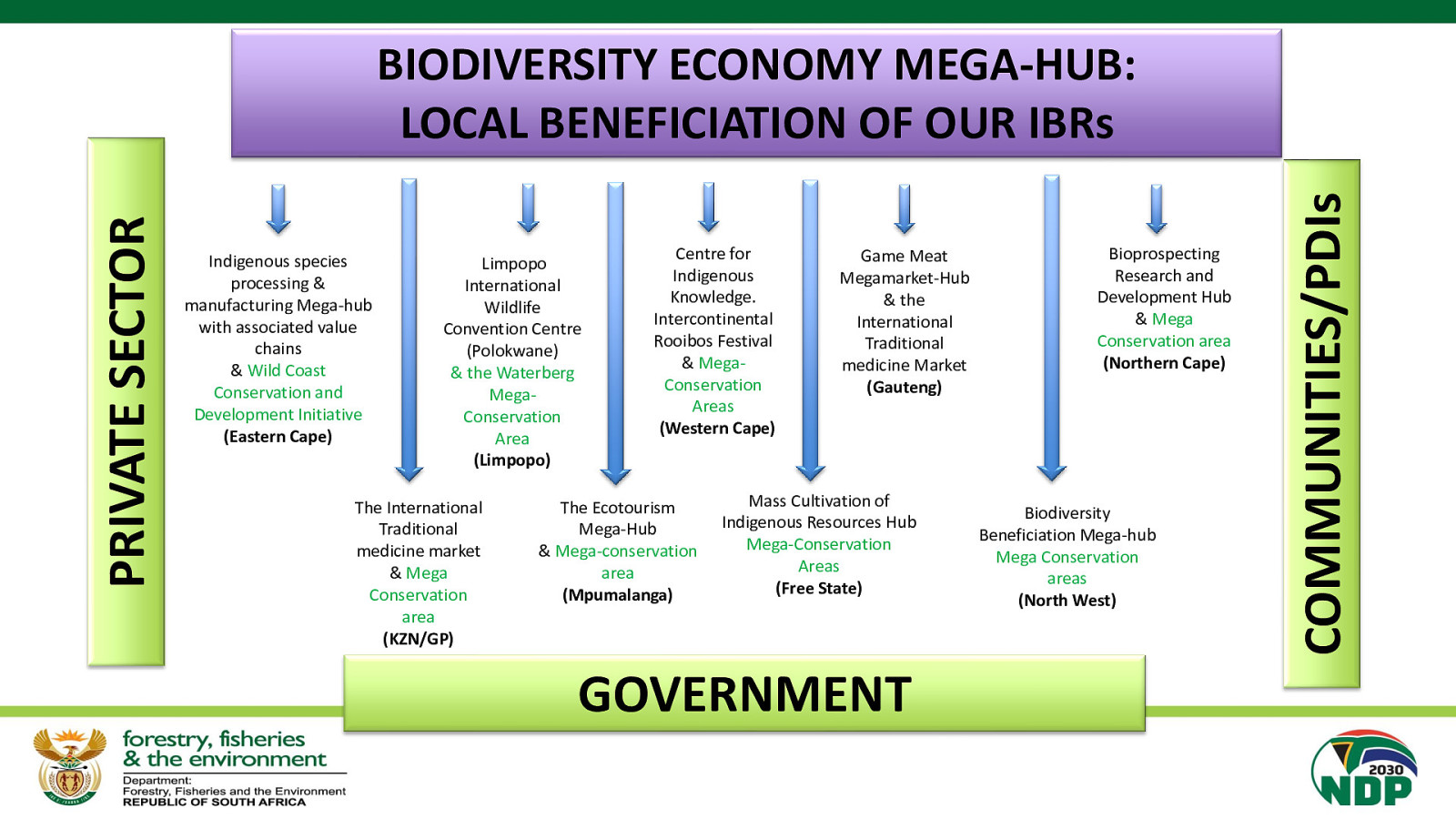
Indigenous species processing & manufacturing Mega-hub with associated value chains & Wild Coast Conservation and Development Initiative (Eastern Cape) Limpopo International Wildlife Convention Centre (Polokwane) & the Waterberg MegaConservation Area (Limpopo) The International Traditional medicine market & Mega Conservation area (KZN/GP) Centre for Indigenous Knowledge. Intercontinental Rooibos Festival & MegaConservation Areas (Western Cape) The Ecotourism Mega-Hub & Mega-conservation area (Mpumalanga) Game Meat Megamarket-Hub & the International Traditional medicine Market (Gauteng) Mass Cultivation of Indigenous Resources Hub Mega-Conservation Areas (Free State) GOVERNMENT Bioprospecting Research and Development Hub & Mega Conservation area (Northern Cape) Biodiversity Beneficiation Mega-hub Mega Conservation areas (North West) COMMUNITIES/PDIs PRIVATE SECTOR BIODIVERSITY ECONOMY MEGA-HUB: LOCAL BENEFICIATION OF OUR IBRs

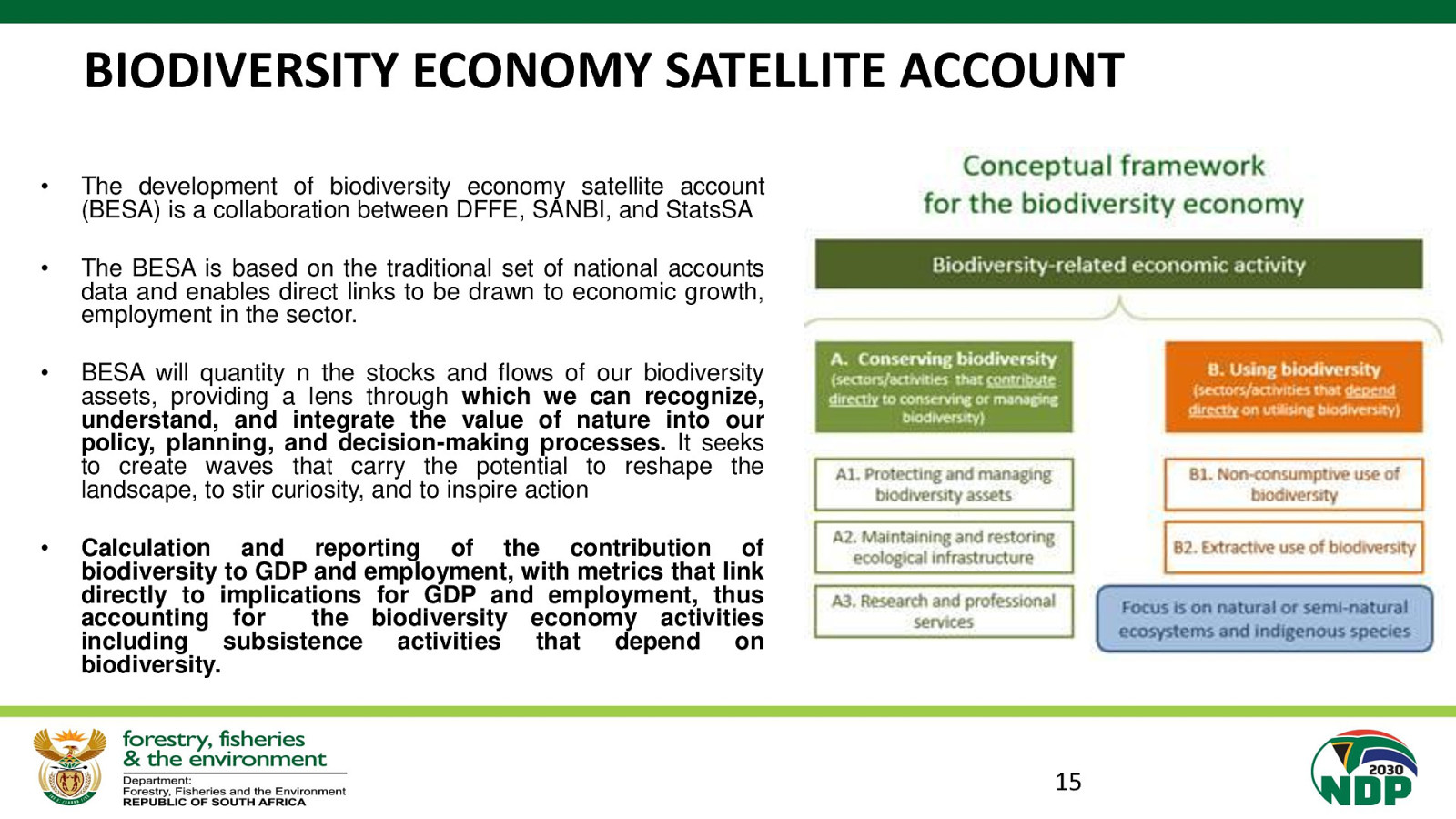
BIODIVERSITY ECONOMY SATELLITE ACCOUNT • The development of biodiversity economy satellite account (BESA) is a collaboration between DFFE, SANBI, and StatsSA • The BESA is based on the traditional set of national accounts data and enables direct links to be drawn to economic growth, employment in the sector. • BESA will quantity n the stocks and flows of our biodiversity assets, providing a lens through which we can recognize, understand, and integrate the value of nature into our policy, planning, and decision-making processes. It seeks to create waves that carry the potential to reshape the landscape, to stir curiosity, and to inspire action • Calculation and reporting of the contribution of biodiversity to GDP and employment, with metrics that link directly to implications for GDP and employment, thus accounting for the biodiversity economy activities including subsistence activities that depend on biodiversity. 15
Mr Khorommbi Matibe Chief Director : Biodiversity Economy & Sustainable Use Department of Forestry, Fisheries and the environment Tel: 012 399 8621|Mobile: 082 566 4257/060 834 2755 Website: http://www.environment.gov.za Address: The Environment House, 473 Steve Biko Road, Arcadia, Pretoria, 0083 Ms Preshanthie Naicker Project Manager: UNDP/GEF 6 Bioprospecting/Biotrade Value Chains Project Mobile l 082 7090 619 Email l PNaicker@dffe.gov.za 16
